Imam W. Deen Mohammed Day: An Illinois Legacy of Faith and Civic Life
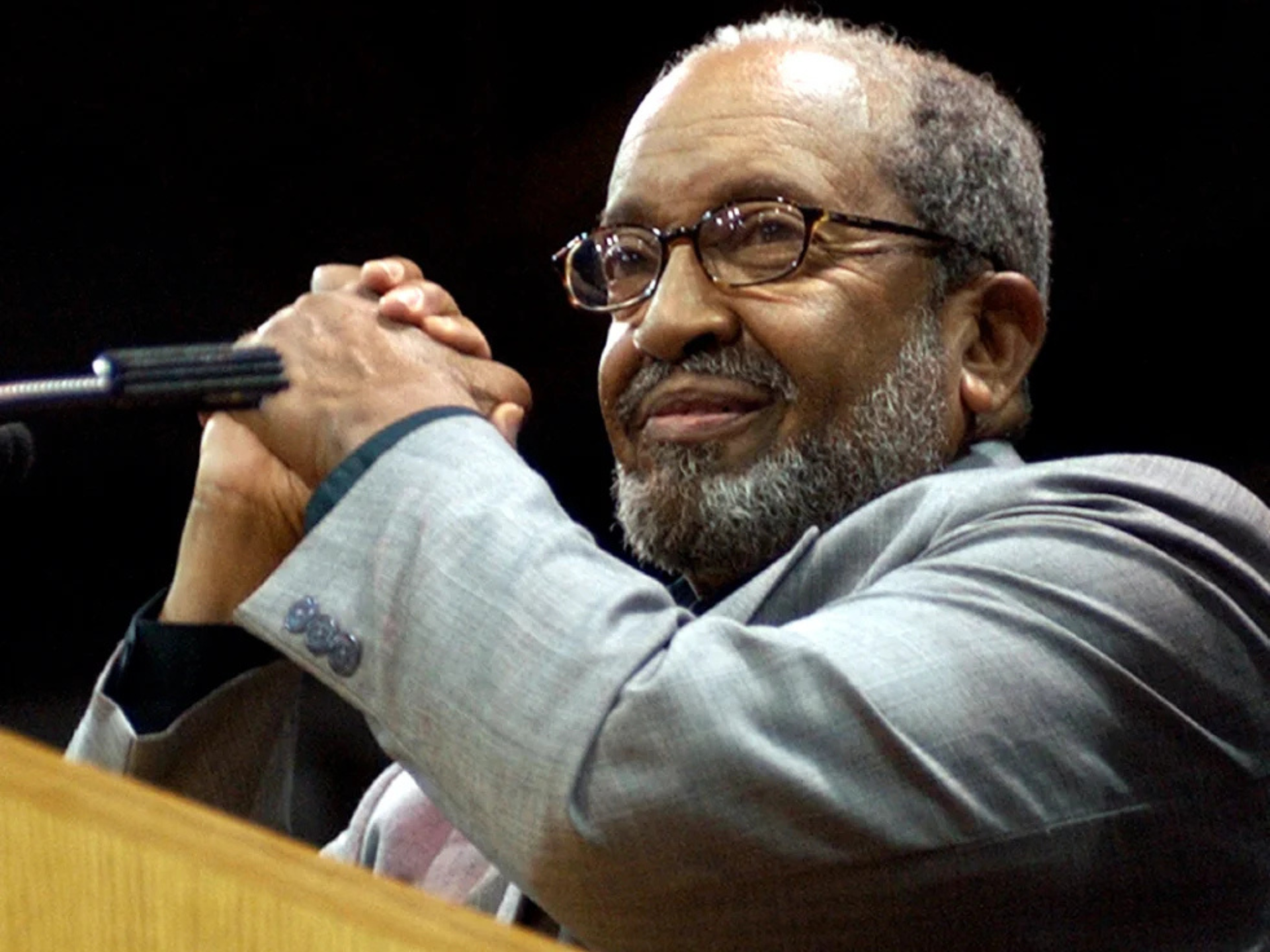
Every September 3, the Village of Hazel Crest honors a leader who taught a generation of Muslim Americans that faith and citizenship were never in conflict.
“We should realize that the first identity is not an African or a European or a Saudi. The first identity is a human being.”
Imam Warith Deen Mohammed built one of the most consequential Muslim communities in American history, and he built it here. He led from Chicago. He died in Markham. The ministry he founded still operates out of East Hazel Crest. Following his passing, the Village of Hazel Crest adopted a resolution establishing Imam W. Deen Mohammed Day, observed every September 3.
This is Illinois Muslim history. It is also American history.
From Wallace to Warith Deen
He was born Wallace D. Muhammad on October 30, 1933, in Hamtramck, Michigan, the seventh child of Elijah and Clara Muhammad.
He began questioning early. At thirteen, alone in the house and frightened, he tried to pray and found he could not picture the God he was calling on. The images around him were of a man. He prayed anyway, asking to be shown correctly. That question never left him.
In 1958 his father appointed him minister of Temple No. 11 in Philadelphia, where he quietly began teaching the Qur'an and Islamic prayer. In 1960 he was convicted of draft evasion and served three years. He spent them studying. He came out convinced that the Prophet Muhammad ﷺ was the final messenger of God — a conviction that put him directly against the teaching he had been raised in. He was excommunicated five times.
The turn
Elijah Muhammad died in February 1975. His son was elected to lead within a day.
He did not adjust the movement. He reversed it. His standard was plain: what agrees with the Qur'an stays, what does not, goes.
He opened membership to all races. He taught that white people were not devils and that his father was not a prophet. Ministers became imams; temples became mosques. He dissolved the Fruit of Islam. He eased the dress and grooming codes. He renamed the organization the World Community of al-Islam in the West in 1976, later the American Muslim Mission, then the American Society of Muslims, and in 2003 founded The Mosque Cares. Many followed. Some did not, and the community split — a rupture he spent decades working to heal, appearing publicly alongside Minister Louis Farrakhan in gestures of unity.
The cost was real. So was the outcome: he moved a mass movement into mainstream Islam without breaking it.
He told his community to show up
This is the part of his legacy that sits closest to our work.
Imam Mohammed did not treat American civic life as a compromise of faith. He treated participation as an obligation.
In 1977 he established New World Patriotism Day and called on his community to vote.
In 1977 he led the largest delegation of Muslim Americans to Hajj in U.S. history.
In 1978 he launched the Committee to Remove All Racial Images of the Divine, opening years of Muslim-Christian dialogue and prompting churches across the country to reconsider racialized religious imagery.
In 1984 he brought 10,000 Muslims to Washington for the first Muslim political convention.
In 1992 he became the first Muslim to deliver the invocation on the floor of the U.S. Senate, and the first to address the Georgia General Assembly.
In 1993 he took part in the inaugural interfaith prayer service for President Bill Clinton.
In 1998 he addressed the Indiana House and delivered the invocation for the Indiana Senate.
Through the 1990s he sent student delegations to Malaysia and to Damascus, and met twice with Pope John Paul II.
He published more than twenty-five books. He founded a committee to advance the role of women in society. He insisted, over and over, that there is no contradiction between living as a Muslim and living as an American citizen.
He was doing civic justice work before we had the phrase for it.
Why we mark this day
The Qur'an tells us we were made into nations and tribes so that we would know one another. Imam Mohammed built a public life around that verse. He held that our shared humanity is the floor everything else stands on, and that difference is meant to be built upward from it, not weaponized against it.
That is the same conviction underneath our work: law made for us must be made with us, and what is made for us should be good for everyone.
We say this carefully. The Black Muslim American story is not ours to narrate. It is the foundation the rest of us are standing on. Roughly a third of Muslims in Illinois are Black, and the institutions, the schools, the mosques, and the political standing that immigrant Muslim communities arrived into were built by people who were already here.
Imam Mohammed's legacy is a reminder that our community's civic power was not granted to us. It was earned, at cost, by people who refused to accept that faith belonged only in private.
Learn more
The Mosque Cares (Ministry of Imam W. Deen Mohammed), East Hazel Crest, Illinois
Muslim American Society, The Legacy of Imam Warith Deen Mohammad Revive Pack
The Atlanta Masjid of Al-Islam: Imam W. Deen Mohammed timeline
Join us for Imam Warith Deen Mohammed Day
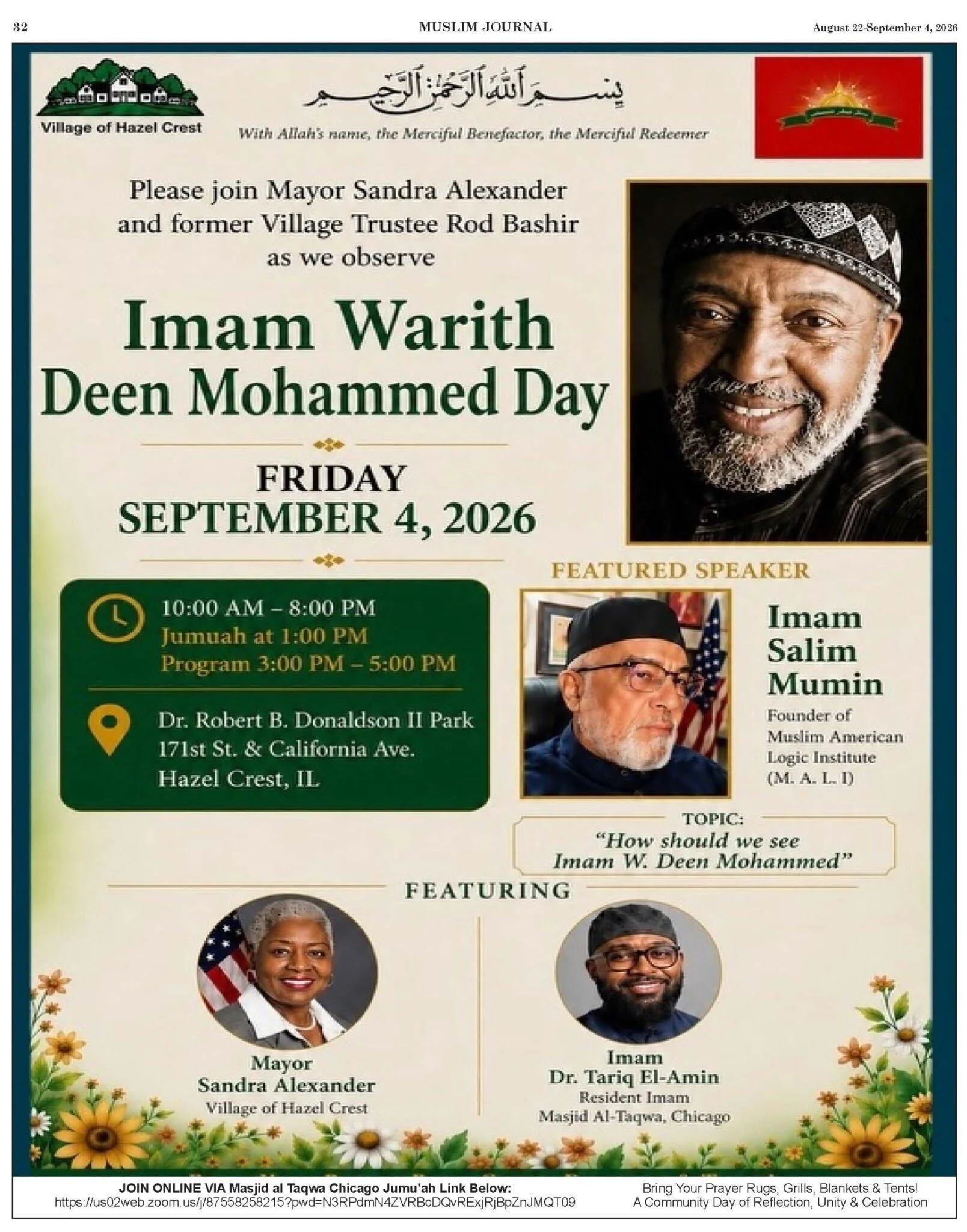
Friday, September 4 | 10 AM – 8 PM
Jumuah at 1 PM | Program 3 – 5 PM
Dr. Robert B. Donaldson II Park, 171st & California Ave., Hazel Crest, IL
Hosted by the Village of Hazel Crest with Mayor Sandra Alexander and former Trustee Rod Bashir. Featured speaker Imam Salim Mumin, with Imam Dr. Tariq El-Amin of Masjid Al-Taqwa Chicago.
A community day of reflection, unity, and celebration.
Bring your prayer rugs, grills, blankets, and tents.
Can't make it in person? Join Jumuah online.